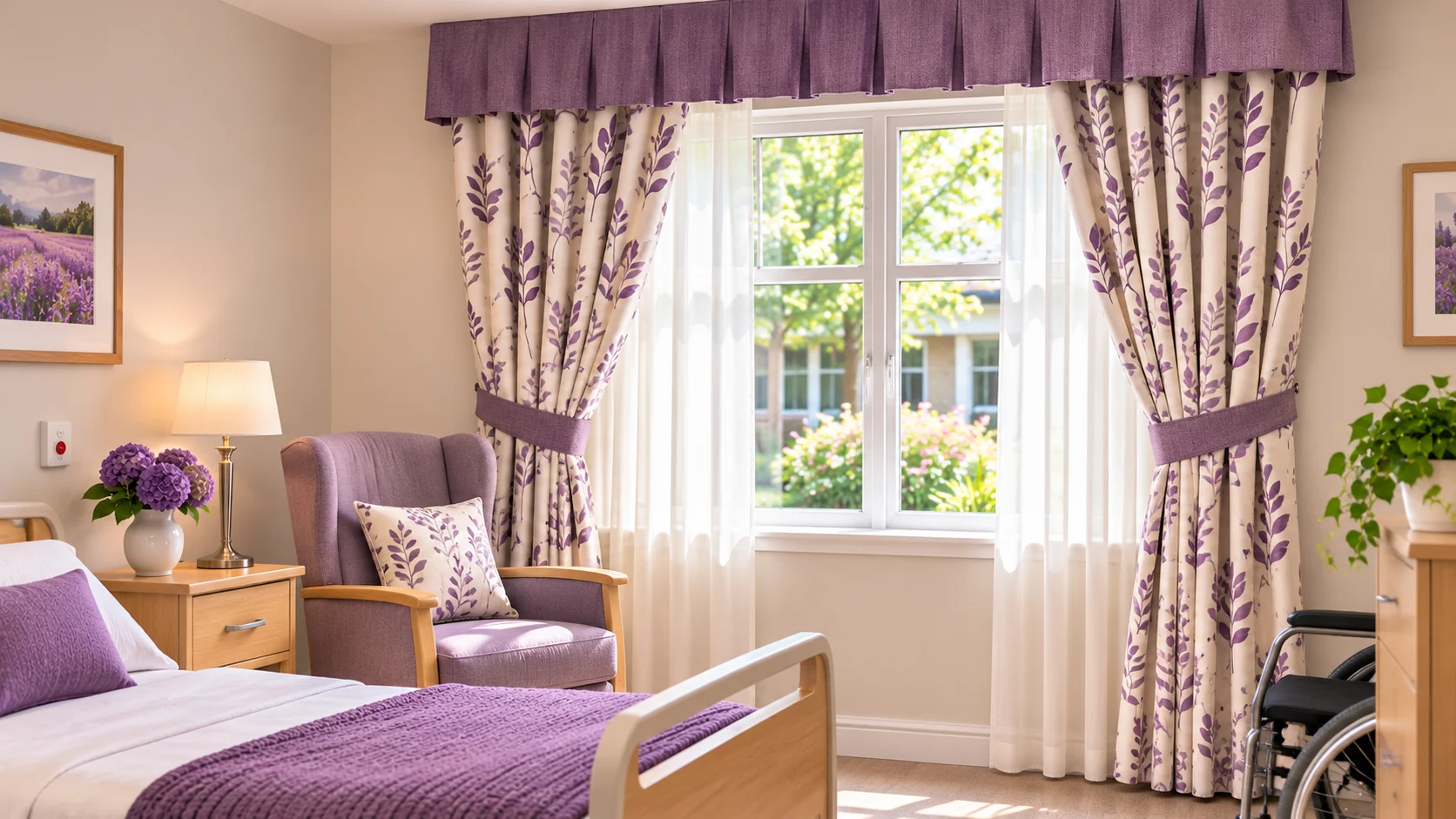
A care home should feel safe, comfortable, and welcoming for the people who live there. While furniture, lighting, and room layouts play important roles in creating that environment, window treatments deserve just as much attention. The right care home curtains can provide privacy, control daylight, improve bedroom comfort, and help communal spaces feel more like home.
However, curtains used in residential care settings need to meet different expectations from ordinary household curtains. Fire safety, infection prevention, easy cleaning, accessibility, and the needs of residents living with dementia all influence the selection process.
A beautiful fabric is not necessarily suitable for a care home. Likewise, an appropriately certified curtain should still be comfortable to use, easy to maintain, and visually appealing.
In this guide, we will explore the best care home curtain styles, suitable materials, fire safety considerations, dementia-friendly designs, and practical buying tips. You will also learn how to measure windows, select appropriate fittings, and create a comfortable environment without overlooking important safety requirements.
What Are Care Home Curtains?
Care home curtains are window treatments selected for residential care homes, nursing homes, assisted living environments, and similar facilities where residents may require additional support with everyday activities.
They perform many of the same functions as household curtains, including providing privacy, reducing glare, controlling daylight, and improving the appearance of a room.
However, care home curtains must also be appropriate for the building’s fire risk assessment, cleaning arrangements, and the abilities of the people using them.
Many suppliers offer contract-grade curtains made from durable, flame-retardant textiles that can withstand appropriate commercial laundering.
Some products feature blackout or dim-out fabrics, while others use lighter materials to create bright, comfortable communal areas.
The best choice depends on the room, its occupants, and the particular care environment.
What Makes Good Care Home Curtains?
The most suitable curtains balance safety, comfort, practicality, and appearance.
Fire performance is an important starting point, particularly in residential buildings where some occupants may need assistance during an emergency.
Fabric maintenance also matters. Curtains can collect dust and become contaminated, so they should be compatible with the care home’s cleaning procedures.
Privacy is another essential consideration. Residents should be able to dress, rest, and receive personal care without unnecessary visibility from outside.
At the same time, suitable window treatments should allow residents to enjoy natural daylight and outdoor views.
Good care home curtains should also be easy to operate, particularly for people with reduced hand strength, limited mobility, or cognitive impairments.
These requirements demonstrate why care home curtain selection should involve more than matching a fabric to the wall color.
Fire Safety Requirements for Care Home Curtains
Fire safety is one of the most important considerations when choosing curtains for a residential care environment.
In England, responsible persons must assess and manage fire risks under applicable fire safety legislation.
The UK government’s fire safety risk assessment guidance for residential care premises explains how fire risk assessment applies to buildings where residents may need assistance during evacuation.
Curtains and other soft furnishings can contribute to fire development, making appropriate textile selection important.
What Is BS 5867 Part 2?
BS 5867 Part 2 is a British Standard used to assess the flammability performance of fabrics intended for curtains and drapes.
Suppliers commonly describe curtain fabrics as meeting Type B or Type C requirements.
These classifications relate to different fire performance testing requirements, with Type C representing a more demanding classification.
However, it is important not to assume that every curtain in every care home must meet the same classification.
The appropriate specification depends on the building, location, intended use, and findings of a competent fire risk assessment.
Before purchasing, request the relevant fabric test documentation and confirm that the specification is suitable for the intended area.
Inherently Flame-Retardant vs. Treated Fabrics
Inherently flame-retardant fabrics are made using fibers designed to provide flame-retardant properties.
Certain specialist polyester fabrics are manufactured using this approach.
Treated flame-retardant fabrics receive a chemical treatment to improve their fire performance.
The important difference is that some treatments can become less effective after repeated washing.
Inherently flame-retardant materials may offer advantages for frequently laundered curtains, although their performance still depends on the exact fabric and care instructions.
Neither type should be described as completely fireproof.
Always verify the relevant test certification, approved cleaning methods, and any limitations on laundering.
Best Fabrics for Care Home Curtains
The ideal fabric should provide appropriate fire performance while remaining comfortable, attractive, and practical to maintain.
Flame-Retardant Polyester
Specialist flame-retardant polyester is a common choice for contract curtains.
It is available in different weights, textures, colors, and decorative finishes.
Depending on the product, it can provide a soft drape, reasonable crease resistance, and compatibility with commercial cleaning processes.
However, not every polyester curtain is flame-retardant.
Buyers should look for certified products rather than assuming that a fabric is suitable because of its fiber content.
Flame-Retardant Blackout Fabric
Blackout curtains can be useful in care home bedrooms where residents need greater control over light.
They are particularly helpful when external street lighting or early morning daylight affects the sleeping environment.
Some products use a separate blackout lining, while others incorporate light-blocking properties into the fabric itself.
The lining and complete curtain assembly should be compatible with the required fire safety specification.
Also remember that blackout fabric does not always eliminate all incoming light. Gaps around the track and curtain edges can reduce its effectiveness.
Washable Contract Upholstery and Curtain Fabrics
Care homes benefit from curtain fabrics that can be maintained without complicated cleaning procedures.
Contract-grade curtain textiles may be designed to tolerate repeated laundering while retaining their appearance.
However, machine-washable does not automatically mean suitable for every care home’s infection-control process.
Check the permitted washing temperature, drying method, colorfastness, shrinkage allowance, and fire-performance durability before purchasing.
Best Care Home Curtains for Different Rooms
A single curtain design may not meet every requirement throughout a care home.
Bedrooms, lounges, dining rooms, and treatment areas serve different purposes and benefit from different window treatments.
Care Home Bedroom Curtains
Bedroom curtains should emphasize privacy, comfortable light control, and ease of use.
Dim-out or blackout curtains can help create suitable sleeping conditions, while lighter curtains may be preferred during daytime.
Consider whether the resident can open and close the curtains independently.
A smooth-running curtain track and a clearly visible operating method can make everyday use easier.
Neutral colors, gentle patterns, and soft textures often create a welcoming bedroom atmosphere.
Our master bedroom dimensions and layout guide explores how furniture placement and room proportions affect comfort and movement.
Although care bedrooms have additional accessibility requirements, careful planning remains equally important.
Care Home Lounge Curtains
Communal lounges should feel bright, comfortable, and inviting.
Light-filtering curtains can help reduce direct sunlight and television glare without making the room unnecessarily dark.
Warm neutrals, muted greens, soft blues, and understated floral designs may complement comfortable seating and natural wooden furniture.
For larger windows, curtains should be easy to draw back fully so residents can enjoy daylight and outdoor views.
Dining Room Curtains
Care home dining rooms benefit from window treatments that support a pleasant environment during meals.
Light-filtering fabrics can reduce glare while maintaining a bright appearance.
Choose durable materials that suit the cleaning arrangements and avoid excessive fabric near areas where food and drinks may be handled.
The curtain design should complement the dining furniture without creating unnecessary visual distractions.
Treatment and Clinical Areas
Rooms used for clinical procedures may need different curtain materials and infection-control arrangements from ordinary residential bedrooms.
Some settings use specialist privacy screens or disposable cubicle curtains rather than conventional window curtains.
These products are not interchangeable simply because they are both described as healthcare curtains.
The appropriate choice should follow the facility’s clinical requirements, local infection-prevention procedures, and relevant fire safety specifications.
Dementia-Friendly Care Home Curtains
Curtain selection deserves additional attention in care environments supporting people living with dementia.
Changes in visual perception, memory, and orientation can affect how people experience their surroundings.
Some residents may find complicated patterns distracting or have difficulty identifying curtain edges and operating mechanisms.
The NHS guidance on making environments dementia-friendly recommends avoiding confusing patterns and using appropriate visual contrast.
Choose Calm, Recognizable Designs
Simple fabrics with gentle colors are often easier to incorporate into dementia-friendly spaces than highly contrasting geometric patterns.
Soft greens, warm blues, peach, beige, and other familiar colors can help create a welcoming atmosphere.
However, dementia-friendly decorating does not mean every room should look identical.
Residents’ preferences, cultural backgrounds, and familiar belongings should influence the overall design.
A subtle floral print that someone has always enjoyed may feel more comforting than an unfamiliar plain fabric.
Make Curtains Easy to Operate
Curtains should move smoothly and should not require excessive pulling force.
Accessible opening methods, suitable handles, and clearly visible curtain edges can support independence.
NHS England’s Health Building Note 08-02 on dementia-friendly environments specifically discusses curtain operability and the importance of reducing frustration.
Window treatments can also reduce reflections in glass after dark, which may cause confusion or distress for some people living with dementia.
The goal is to support independence while accounting for individual safety needs.
Privacy, Daylight, and Temperature Control
Care home curtains should create privacy without permanently blocking beneficial natural light.
In bedrooms, residents may prefer greater privacy during personal care, dressing, and rest.
A combination of light-filtering and heavier curtains can provide flexibility throughout the day.
However, any layered installation must meet the applicable fire and maintenance requirements.
During warm weather, appropriate curtains may help reduce direct solar gain, while heavier designs can reduce some heat loss through windows.
The actual thermal benefit depends on fabric construction, curtain fit, glazing, and how the window treatments are used.
Curtains should not obstruct essential ventilation or prevent the operation of window restrictors and other safety features.
Choosing Safe Curtain Tracks and Fittings
Curtain tracks are just as important as the fabric because they determine how the curtains operate.
Commercial tracks are often designed for frequent use and may feature smooth-running gliders and durable fittings.
For residents with limited mobility or hand strength, an easy-to-operate track can improve comfort and independence.
Motorized curtain systems may be appropriate in selected rooms, particularly where residents cannot safely reach the window.
However, electrical systems require appropriate installation and maintenance.
Loose operating cords can create hazards, and certain rooms may need specialist anti-ligature or load-release fittings following an individual risk assessment.
There is no single fitting that is suitable for every care home resident or room.
Avoid low-hanging fabric that creates a trip hazard or catches on mobility equipment. Make sure tracks and fixing points are structurally suitable for the installed curtains.
How to Measure Care Home Curtains Correctly
Accurate measurements help curtains operate smoothly and provide the intended privacy and light control.
Start by deciding whether the installation will use a curtain pole or a track.
Measure the full usable width of the pole or track rather than just the visible window glass.
Curtains generally need additional fabric width to create folds when closed.
Depending on the heading style, a supplier may recommend approximately 1.5–2.5 times the track width in fabric fullness.
However, this is only an illustrative range. The correct amount depends on whether the curtains use pencil pleats, pinch pleats, wave headings, or another system.
Next, measure the drop from the appropriate hanging point to the desired curtain hem.
Consider whether the curtains should finish just above the floor, at the windowsill, or at another suitable position.
In care homes, avoiding trailing fabric is particularly important for mobility and housekeeping.
Measure every window individually, even when several appear identical.
For larger refurbishment projects, a professional site survey can reduce mistakes and help identify difficult installation conditions.
Cleaning and Maintaining Care Home Curtains
Regular cleaning is essential because curtains are part of the occupied environment and may become dusty or contaminated.
The Care Quality Commission’s infection prevention and control guidance emphasizes appropriate environmental cleanliness and laundry arrangements in care homes.
Curtains should be included in a documented cleaning schedule, with additional cleaning or replacement when contamination or an outbreak makes it necessary.
How Often Should Care Home Curtains Be Washed?
There is no single washing interval appropriate for every curtain and care setting.
Frequency depends on the room, resident needs, infection risk, visible soiling, and local cleaning policy.
Care home infection-prevention guidance recommends establishing a routine schedule for changing or cleaning curtains and blinds.
Follow the manufacturer’s laundering instructions alongside the home’s infection-control procedures.
Do not assume that every fabric can be washed at 60°C or subjected to industrial thermal disinfection.
If the curtain cannot tolerate the required cleaning process, it may not be suitable for the intended environment.
After cleaning, inspect the fabric, seams, hooks, and fire-performance documentation to confirm that the curtains remain suitable for use.
How Much Do Care Home Curtains Cost?
Care home curtain prices vary depending on fabric specifications, window dimensions, lining requirements, heading style, installation, and order quantity.
A small ready-made curtain panel may be less expensive than a custom-sized contract curtain, but ordinary household curtains may not meet the facility’s requirements.
Made-to-measure products can cost more initially but may provide better coverage, suitable fabric certification, and a more reliable fit.
Some suppliers offer site surveys, fitting services, and project quotations for multiple rooms.
When comparing prices, request a complete quotation that includes fabric, lining, tracks, installation, delivery, and any required documentation.
The lowest purchase price does not necessarily represent the best long-term value if cleaning, replacement, and maintenance costs are higher.
What to Check Before Buying Care Home Curtains
Before placing an order, verify the exact requirements of the room rather than relying on a general description such as “healthcare curtains.”
The most important details include:
- Appropriate fire-performance certification for the intended use.
- Fabric cleaning instructions and compatibility with infection-control procedures.
- Suitable dimensions, heading style, and curtain track.
- Privacy, daylight control, accessibility, and resident preferences.
- Installation safety, warranty, and replacement availability.
Request physical fabric samples whenever possible.
Examining the fabric in the actual room can help you judge its texture, opacity, pattern, and appearance under natural and artificial lighting.
For broader decorating guidance, our complete guide to home decorating explains how window treatments, lighting, furniture, and color work together to create comfortable spaces.
Common Mistakes to Avoid When Choosing Care Home Curtains
A common mistake is purchasing ordinary domestic curtains without checking whether they meet the facility’s fire safety requirements.
Another is selecting a visually attractive material that cannot tolerate the required cleaning arrangements.
Buyers may also overlook the importance of curtain tracks, particularly when residents have limited mobility.
Busy patterns and poorly considered color combinations can create unnecessary visual complexity for some residents living with dementia.
Finally, avoid using the same curtain specification throughout every room without considering different activities and individual needs.
A bedroom, lounge, and clinical treatment room may require substantially different solutions.
Frequently Asked Questions About Care Home Curtains
Care home curtains should have fire performance appropriate to the premises’ fire risk assessment and applicable requirements. In the UK, BS 5867 Part 2 is commonly referenced for curtain fabrics. The specific classification should be confirmed with the responsible person or a competent fire safety professional.
Certified flame-retardant contract fabrics are frequently suitable because they are available in practical finishes and can be selected for appropriate cleaning processes. Inherently flame-retardant polyester is one option, but the best fabric depends on the room and its requirements.
Yes. Blackout curtains can support privacy and reduce unwanted light during rest periods. However, choose a product with suitable fire-performance documentation and a design that residents can operate safely.
Gentle, familiar colors and simple patterns are often suitable. Avoid unnecessarily busy or disorientating designs, but consider personal preferences and appropriate contrast. There is no single color that works best for everyone living with dementia.
Ordinary household curtains should not automatically be assumed suitable. Their fire certification, cleaning properties, installation, and compatibility with the care home’s risk assessments must be established before use.
Washable curtains may be easier to maintain in facilities with established laundry systems. However, the fabric must tolerate the actual required cleaning process without losing necessary performance. Dry-clean-only products may be less convenient for some settings.
Resident choice is an important part of creating a personal and welcoming environment. However, any curtains brought from home must still be assessed for suitability, fire safety, installation, and maintenance requirements.
Care home window curtains generally emphasize residential comfort, privacy, light control, and homely decoration. Hospital cubicle curtains are often designed for clinical privacy and may have different hygiene, replacement, and track requirements.
Creating Comfortable, Safe, and Welcoming Care Home Spaces
The right care home curtains can improve more than the appearance of a room. They can support privacy, comfortable rest, natural light management, independence, and the familiar atmosphere that helps residents feel at home.
However, attractive window treatments should never take priority over essential safety and maintenance requirements.
Start by identifying the needs of each room, confirm the appropriate fire-performance specification, and select fabrics that work with the home’s cleaning procedures.
Then consider residents’ preferences, accessibility, colors, and how the curtains will function throughout the day.
With careful planning and suitable products, care home curtains can help create living environments that are practical for staff, comfortable for residents, and welcoming for visiting families.