A comfortable dining environment can make everyday meals more enjoyable, especially for older adults and people who need additional physical support. In care homes, nursing facilities, assisted living communities, and healthcare settings, the right dining chairs contribute to much more than appearance. They can support independence, make sitting and standing easier, and help create a welcoming space where residents feel comfortable spending time together.
Unlike ordinary household dining chairs, healthcare dining chairs are often designed with stronger frames, supportive armrests, durable upholstery, and surfaces suitable for frequent cleaning. Some models also include specialist features such as ski-style legs, rear transport wheels, or additional seating support.
However, not every healthcare chair is suitable for every resident. Seat height, depth, stability, cushioning, mobility needs, and the surrounding dining table all influence comfort and usability.
This guide explores healthcare dining chair styles, essential features, dimensions, materials, fire safety standards, and practical buying considerations. Whether you are furnishing a care home dining room or replacing existing seating, you will learn how to choose chairs that balance safety, comfort, durability, and a homely appearance.
What Are Healthcare Dining Chairs?
Healthcare dining chairs are seating products designed or selected for dining areas in care homes, nursing homes, rehabilitation settings, assisted living facilities, and other environments where people may have additional mobility or support needs.
Their main purpose is to provide comfortable, stable seating while making everyday activities such as eating, sitting down, and standing up as manageable as possible.
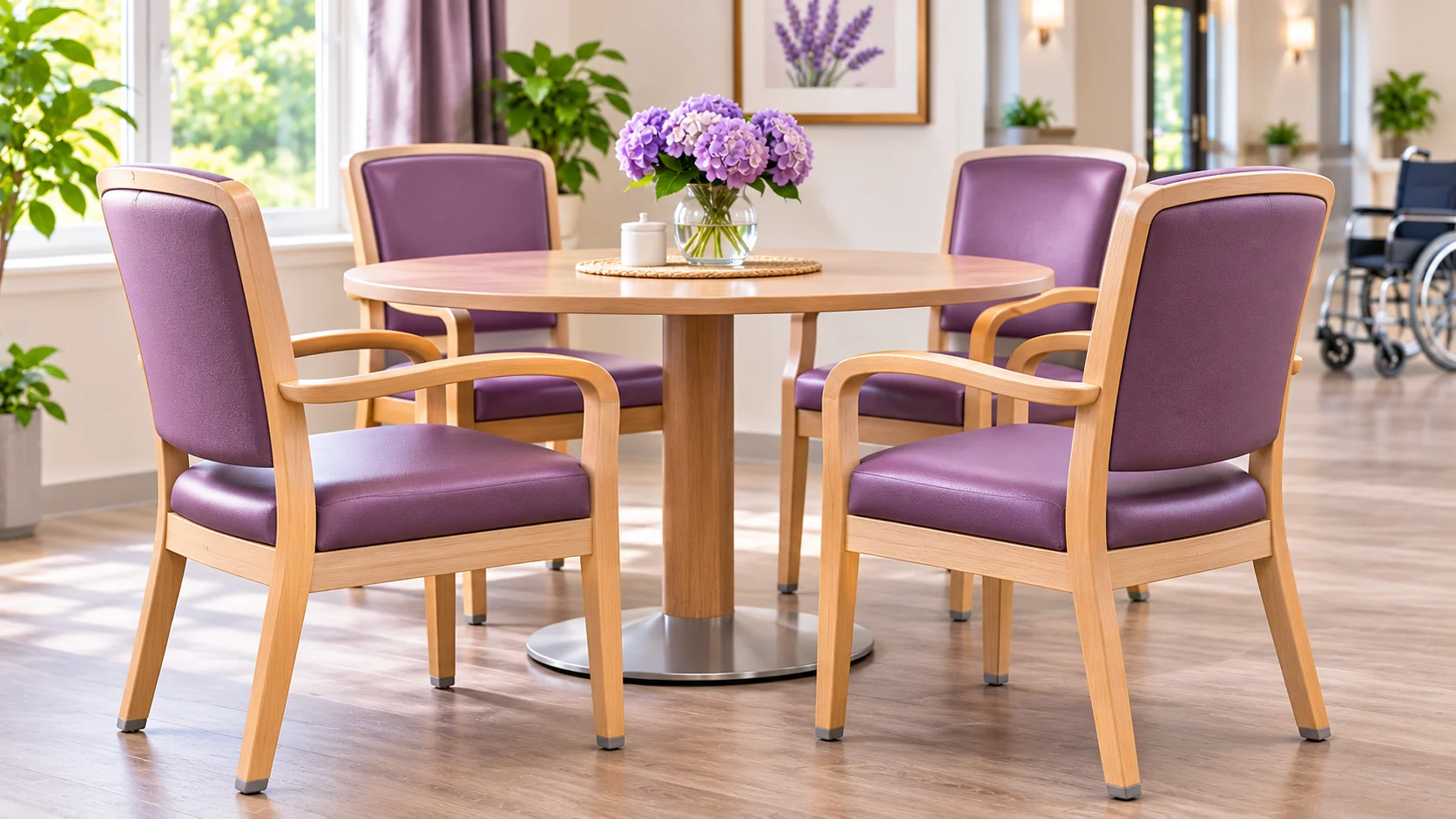
Many healthcare dining chairs feature solid wooden frames, padded seats, supportive backs, and armrests positioned to assist residents.
They may also include wipe-clean upholstery, moisture-resistant materials, and construction intended for frequent institutional use.
Although healthcare dining chairs sometimes resemble ordinary residential furniture, their specifications should reflect the needs of the users and the environment.
A chair suitable for a relatively independent resident may not provide adequate support for someone who has difficulty maintaining an upright sitting position.
For this reason, furniture selection should consider individual needs rather than relying entirely on appearance or marketing descriptions.
Why Choosing the Right Healthcare Dining Chairs Matters
Mealtimes are important opportunities for nutrition, social interaction, independence, and personal enjoyment.
Poorly fitting chairs can make these activities unnecessarily difficult.
For example, a seat that is too low may require greater physical effort when standing. A seat that is too high may leave someone’s feet unsupported, creating discomfort and an insecure sitting position.
Research published in Seating in Aged Care: Physical Fit, Independence and Comfort identifies seat height, seat dimensions, and armrests as important factors affecting comfort and the ability to rise from a chair.
Appropriate seating can also make it easier to position someone close to the dining table.
This matters because residents should be able to reach their meals comfortably without leaning forward excessively.
The best healthcare dining chairs therefore support everyday activities while maintaining a familiar, welcoming environment.
Different Types of Healthcare Dining Chairs
Healthcare dining seating is available in several designs. The most appropriate option depends on mobility, comfort, cleaning requirements, and how the dining space is used.
Healthcare Dining Chairs With Arms
Dining chairs with armrests are a common option in care homes and nursing facilities.
Their armrests provide a place for residents to rest their arms and may offer support during sitting and standing.
A well-designed chair should have stable, appropriately positioned arms that can be gripped or pressed against as needed.
However, the armrests must also work with the dining table.
If they are too high to fit beneath the table, a resident may struggle to sit close enough to eat comfortably.
The chair’s size should be selected according to the person using it, rather than assuming every resident benefits from identical seating.
Healthcare Dining Chairs Without Arms
Armless healthcare dining chairs offer a simpler, more compact seating arrangement.
They can be useful in dining spaces where floor area is limited or where users do not require additional support from armrests.
Their open sides can also allow different approaches to sitting, although this is not appropriate for every transfer method.
For residents who need help standing or maintaining balance, an armless chair may be less suitable.
Before selecting this design, consider whether the intended users can enter and leave the chair safely.
Healthcare Dining Chairs With Skis
Some care home dining chairs feature ski-style extensions along their legs.
These designs are intended to offer particular stability or movement characteristics, depending on the manufacturer’s construction.
For example, UK supplier Carechair offers dining chairs with optional ski slides, armrests, and specialist movement features.
However, ski-style legs do not automatically make every chair safer for every resident.
Their suitability depends on floor surfaces, chair design, mobility needs, and the manufacturer’s instructions.
Stackable Healthcare Dining Chairs
Stackable dining chairs are designed for flexible spaces where seating arrangements change frequently.
They may be useful in activity rooms, communal dining areas, and multipurpose facilities.
However, a stackable design should still provide appropriate comfort and stability.
Check the manufacturer’s maximum stacking quantity, handling instructions, and intended use.
Essential Features of Comfortable Healthcare Dining Chairs
The right combination of support, dimensions, and construction can make a significant difference to everyday comfort.
Supportive Backrests
A healthcare dining chair should provide suitable back support without forcing the user into an uncomfortable position.
A moderately upright backrest may make it easier to sit close to the dining table than a deeply reclined design.
However, backrest shape should also accommodate the person’s posture.
Some residents may require additional support recommended by an occupational therapist or other qualified professional.
Firm but Comfortable Cushions
Soft seating can feel inviting, but excessive cushioning may make standing more difficult.
When a cushion compresses too far, the effective seat height becomes lower and the user may struggle to rise.
A supportive cushion should provide comfort while retaining enough firmness for the intended activity.
The correct solution varies between individuals, particularly when pressure management or significant mobility limitations are involved.
Stable Frames and Rounded Edges
A healthcare dining chair should remain stable during normal use.
Frames must withstand the expected loads, and joints should feel secure without excessive movement.
Smooth, rounded edges can reduce discomfort when users rest their arms or hands against the furniture.
The chair’s feet should also be compatible with the floor surface to reduce unwanted sliding while allowing safe repositioning.
Healthcare Dining Chair Dimensions and Seat Heights
One of the most important buying considerations is whether the chair fits the person using it.
Standard dimensions can provide a starting point, but they should never replace individual assessment.
What Is a Suitable Seat Height?
Many healthcare dining chairs have seat heights around 45–49 cm, although different models may fall outside this range.
For example, the Leona healthcare dining chair has a published seat height of 460 mm, or approximately 18.1 inches.
Its standard version measures 430 mm wide, while the version with armrests measures 560 mm wide overall.
These examples demonstrate how adding armrests can significantly affect the space required for a chair.
A suitable seat height should allow the user’s feet to rest securely on the floor when appropriate and enable them to stand using their normal, assessed transfer method.
A taller chair is not automatically more comfortable.
Seat Depth and Width
Seat depth affects how well the thighs and back are supported.
If the seat is too deep, a shorter resident may be unable to sit against the backrest while maintaining comfortable leg positioning.
If it is too shallow, the thighs may receive insufficient support.
Seat width is equally important.
The chair should accommodate the person’s body comfortably while allowing them to use the armrests effectively.
When selecting furniture for multiple residents, offering more than one size may be more practical than purchasing identical chairs throughout the facility.
Matching Chairs With Dining Tables
The chair and dining table should work together.
Armrests need enough clearance beneath the tabletop, while the seat height should allow comfortable access to food and drinks.
Table aprons, support rails, and pedestal bases can affect legroom.
Our cross back dining chair guide explains general chair dimensions and table pairing, although healthcare seating requires additional attention to individual support and accessibility.
Best Upholstery Materials for Healthcare Dining Chairs
Upholstery plays an important role in comfort, durability, and cleaning.
Healthcare-Grade Vinyl
Healthcare-grade vinyl is commonly used in dining areas because suitable products can provide a wipe-clean surface.
It may be particularly practical where food spills or moisture are common.
However, not every vinyl is resistant to the same cleaning chemicals.
Check the manufacturer’s cleaning and disinfection compatibility information before selecting a fabric.
Contract-Grade Upholstery Fabric
Contract-grade fabrics are designed for more demanding use than some ordinary domestic textiles.
They may offer increased abrasion resistance, moisture protection, or specialized surface treatments.
Fabric upholstery can create a softer, more residential appearance, making dining spaces feel welcoming.
However, tightly woven fabric is not necessarily fluid-resistant or suitable for the facility’s cleaning procedures.
Are Antimicrobial Fabrics Necessary?
Some healthcare seating products advertise antimicrobial upholstery.
These treatments may be designed to limit the growth of certain microorganisms on the material, depending on the product’s tested claims.
However, antimicrobial upholstery does not replace effective cleaning, disinfection, or infection-prevention procedures.
The Association for the Health Care Environment’s furniture cleanability guidance emphasizes choosing materials compatible with the cleaning agents and methods used in the facility.
The most important consideration is whether the chair can be cleaned effectively without damaging the upholstery or frame.
Fire Safety Standards for Healthcare Dining Chairs
Fire safety should be considered whenever dining chairs are purchased for a healthcare or residential care environment.
In the UK, BS 7176 is a relevant standard for evaluating the ignition resistance of upholstered seating used in non-domestic settings.
Many suppliers describe products as meeting BS 7176 Medium Hazard requirements or BS 5852 Ignition Source 5, commonly called Crib 5.
However, these descriptions should not be treated as proof that every product is suitable for every care facility.
The appropriate fire performance depends on the setting, the furniture’s construction, the applicable requirements, and the premises’ fire risk assessment.
Importantly, upholstery fire performance involves more than the outer fabric alone. Buyers should request documentation relevant to the complete upholstered construction.
For structural durability, BS EN 16139:2025 addresses safety, strength, and durability testing for non-domestic seating within its defined scope.
A chair’s testing standard should not be confused with its advertised safe working load.
Before ordering, confirm relevant certificates, weight ratings, and any additional requirements with the responsible facilities or fire safety professional.
Dementia-Friendly Healthcare Dining Chairs
Residents living with dementia may experience changes in visual perception, orientation, and their ability to recognize surrounding objects.
Thoughtful furniture selection can help create a more comfortable and understandable environment.
Use Clear Color Contrast
A chair that visually blends into the flooring may be difficult for some people to identify.
Using suitable contrast between the seat, floor, and surrounding furniture can make seating more recognizable.
The NHS guidance on dementia-friendly environments recommends appropriate visual contrast and avoiding potentially confusing bold patterns.
However, individual preferences and needs remain important.
Not every person living with dementia experiences visual changes in the same way.
Create Familiar, Welcoming Dining Spaces
Healthcare dining rooms do not need to look institutional.
Wooden chair frames, comfortable upholstery, warm colors, and simple furnishings can create a familiar atmosphere.
The Victorian Department of Health’s dementia-friendly dining guidance recommends supportive chairs, suitable table heights, and dining arrangements that encourage social interaction.
Small dining groups may feel more comfortable than large, crowded seating arrangements for some residents.
Allowing residents to express preferences about where they sit can also support a more personal dining experience.
How to Arrange Healthcare Dining Chairs Safely
A practical dining room layout should accommodate residents, staff, mobility aids, and everyday movement.
Avoid positioning chairs so closely together that people struggle to enter or leave their seats.
There should also be sufficient space for wheelchairs, walking frames, and any assessed assistance requirements.
The exact circulation space depends on the building and applicable accessibility guidance rather than a single universal measurement.
Consider the type of tables used.
Pedestal tables can sometimes provide more flexible wheelchair access than tables with legs at each corner, although their stability and dimensions must be checked.
Lighting should minimize glare while allowing food and table surfaces to remain clearly visible.
For a coordinated interior, our complete guide to home decorating explains how furniture scale, lighting, and room layouts influence everyday comfort.
How Much Do Healthcare Dining Chairs Cost?
Healthcare dining chair prices vary depending on frame construction, upholstery, specialized features, quantity, and supplier.
A basic commercial dining chair may cost less than a fully upholstered care home armchair with ski-style legs or specialist movement features.
Contract fabrics, custom finishes, and additional support options can also affect pricing.
Many UK healthcare furniture suppliers provide quotations for larger projects rather than one universal price.
When comparing offers, ask for the total cost, including delivery, assembly, upholstery upgrades, and applicable taxes.
The cheapest chair may not provide the best value if it wears quickly or requires frequent replacement.
Durability, cleanability, warranty coverage, and spare-part availability should influence the buying decision.
How to Choose a Reliable Healthcare Dining Chair Supplier
A suitable supplier should provide clear technical specifications rather than relying only on attractive product photographs.
Ask for accurate dimensions, upholstery options, weight limits, construction details, fire-performance documentation, and cleaning instructions.
For example, UK Healthcare Chairs publishes dimensions and material information for its Leona dining chair range, while Carechair offers different armrest and frame configurations.
These examples illustrate the level of detail buyers should request.
Before ordering a large quantity, consider obtaining a sample chair so residents and staff can assess its suitability.
Where residents have additional mobility or postural needs, an occupational therapist or other appropriate clinician should be involved in assessing seating.
A short practical trial may reveal problems that are difficult to identify from a product specification sheet.
Cleaning and Maintaining Healthcare Dining Chairs
Healthcare dining chairs should be maintained according to the facility’s cleaning schedule and the manufacturer’s instructions.
Food spills should be addressed promptly using a cleaning method appropriate for the upholstery.
Frequently touched areas, including armrests, seat edges, and backrests, deserve particular attention.
The UK government’s infection prevention and control guidance for adult social care explains how cleaning and disinfection should reflect the risk of contamination and the type of equipment involved.
Avoid using strong disinfectants without confirming compatibility with the material.
Some chemicals may damage protective coatings, discolor upholstery, or weaken furniture finishes over time.
Inspect chairs regularly for torn fabric, loose joints, unstable legs, damaged armrests, and worn floor glides.
Remove damaged chairs from use when necessary until they have been appropriately assessed and repaired.
Common Mistakes to Avoid When Buying Healthcare Dining Chairs
A common mistake is purchasing chairs based entirely on appearance or price.
An attractive chair may still have the wrong seat height, inadequate support, or upholstery unsuitable for frequent cleaning.
Another mistake is choosing identical chairs for every resident without considering differences in height, mobility, and posture.
Buyers should also avoid assuming that words such as “antimicrobial,” “Crib 5,” or “commercial-grade” automatically establish complete suitability for a specific healthcare environment.
Check the relevant product documentation and risk assessments.
Finally, do not overlook the relationship between the chair and dining table.
A supportive chair can still be impractical if its arms prevent residents from sitting close enough to their meals.
Frequently Asked Questions About Healthcare Dining Chairs
Healthcare dining chairs are seating products designed or selected for use in care homes, nursing facilities, and other healthcare environments. They typically emphasize stable construction, comfortable support, durability, and materials compatible with appropriate cleaning procedures.
Chairs with armrests can help some older adults when sitting down or standing up. However, the correct design depends on individual mobility, body proportions, and transfer needs. Armrests should also allow comfortable access to the dining table.
There is no universal ideal height. Many healthcare dining chairs have seats around 45–49 cm high, but the correct height depends on the individual. Feet should be adequately supported, and the person should be able to sit and stand using their assessed method.
Healthcare seating should meet the fire safety requirements appropriate to the premises and intended use. In the UK, BS 7176 is commonly referenced for non-domestic upholstered seating. The required performance should be determined through the relevant fire risk assessment.
Wipe-clean upholstery can make routine cleaning more manageable, especially in busy dining areas. However, the material must be compatible with the facility’s approved cleaning products and infection-control procedures.
Suitable chairs should provide appropriate comfort and support, stable construction, recognizable visual contrast, and easy access to dining tables. Individual preferences and mobility requirements should guide the final choice.
Some domestic-style chairs may be suitable in particular circumstances, but appearance alone is not enough. Their structural performance, fire safety, cleanability, stability, and suitability for intended users must be assessed before use.
Not necessarily. Residents differ in height, mobility, body proportions, and support needs. Offering different chair sizes or configurations can help provide more comfortable and appropriate seating.
Create a Dining Space That Supports Comfort and Independence
The best healthcare dining chairs combine practical support with thoughtful design. They should help residents sit comfortably, access meals easily, and participate in everyday dining activities while remaining suitable for the care environment.
A good buying decision begins with understanding the needs of the people who will use the chairs.
Compare seat heights, armrests, upholstery, stability, cleaning requirements, and relevant safety documentation before making a purchase.
Whenever possible, test sample chairs and involve residents, care staff, and appropriate healthcare professionals in the selection process.
With carefully chosen seating and a welcoming room layout, healthcare dining areas can become spaces where comfort, independence, safety, and social connection are equally valued.